|
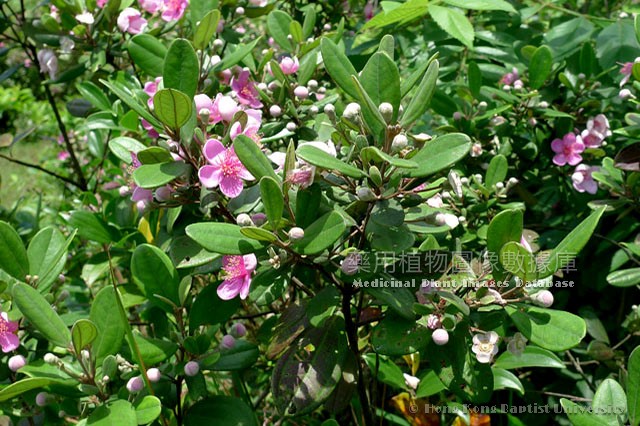
Rhodomyrtus tomentosa (Ait.) Hassk. Fl. Beihl.
|
English Name |
Rose Myrtle, Downy Rosemyrtle, Rosemyrtle, Hill Gosseberry, Downy Rose Myrtle |
|
Latin name |
Rhodomyrtus tomentosa (Ait.) Hassk. Fl. Beihl. |
|
Family & Genus |
Myrtaceae, Rhodomyrtus |
|
Description |
Shrub, height up to1-2m. Young shoots densely greyish pilose. Leaves opposite, oblong or obovate, leaf blade coriaceous, length 3-8cm, width 1-4cm, apex rounded or obtuse, often retuse, base broadly cuneate or cuneate, glabrous above or only hairy when young, below greyish white tomentose, entire, tri-quinqueplinerved directly to the leaf tip, lateral veins 7-8 on each side, marginal vein 3-4mm from the leaf edge; petiole length 4-7mm, tomentose. Flowers with long stem, often solitary, purplish red, diameter 2-4cm; calyx tube obovate, ca. 6mm long, grey tomentose, base with 2 ovate bracteoles, calyx teeth 5, suborbicular, 4-5mm long, persistent; petals 5, obovate, 1.3-2cm long; grey tomentose outside; stamens red, 7-8mm long, anther longitudinally split, rounded; ovary inferior, 3 chambers, style 1cm long, base tomentose, stigma enlarged, head-shaped. Fruit as berry, ovoid pot shape, length 1.5-2cm, width 1-1.5cm, violet black when ripe, seeds numerous, 2 rows every chamber. Flowering: April to May, fruiting: July to August. |
|
Distribution |
Growing on hill-slopes and acid soil. Distributed in Southeast Zhejiang, Taiwan, Fujian, South Jiangxi, South Hunan, Guangdong, Hong Kong, Hainan, Guangxi, South Guizhou and Southeast Yunnan. The medicinal materials are mainly produced in Taiwan, Fujian, Guangdong, Guangxi, Yunnan, Guizhou and South Hunan. |
|
Part Used |
Medical part: fruits, flowers, leaves and roots. Fruits: Taojinniang. Flowers: Taojinnianghua. Leaves: Shanrenye. Roots: Shanrengen. |
|
Harvest & Processing |
Fruits: collected when fruits mature in autumn, and sun-dried. Flowers: harvested from April to May, used fresh or dried in the shade. Leaves: can be harvested throughout the year, used fresh or sundried. Roots: can be harvested throughout the year, washed, chopped into segments, and used fresh or sundried. |
|
Chemistry |
Leaves contain betulinic acid, ursolid acid, aliphitolic acid, lupeol and betulin, etc. Stem contains betulonic acid, betulinic acid, oleanolid acid, friedelin, lupeol, taraxerol, berulin-3-acetate and tannin, etc. Roots contain phenoloid and tannin. |
|
Pharmacology |
Fruits: inhibitive on staphylococcus aureus. |
|
Properties & Actions |
Fruits: taste sweet, harsh, neutral in nature. Flower: taste sweet, harsh, and neutral in nature. Leaves: taste sweet, neutral in nature. Root: taste pungent, sweet, and neutral in nature.Fruits: nourishing the blood and relieving hemorrhage, inducing astringency to the intestine and controlling nocturnal emission. Flowers: astringency and relieving hemorrhage. Leaves: disinhibiting dampness, relieving diarrhea, engendering flesh and relieving hemorrhage. Roots: regulating qi-flowing for suppressing pains, disinhibiting dampness, relieving diarrhea, dispelling stasis and relieving hemorrhage, benefiting kidney qi and nourishing the blood. |
|
Indications & Usage |
Fruits: used for hemopenia and physical weakness, hematemesis, epistaxis, hemoptysis due to impairment caused by overstrain, hemafecia, metrorrhagia and metrostaxis, emissions, leukorrhea, dysentery, anal prolapse, scalding injuries, hemorrhage caused by trauma. Flower: used for hemoptysis, empsyxis, and epistaxis. Leaves: used for diarrhea, dysentery, jaundice, headache, gastralgia, malnutritional stagnation, metrorrhagia and metrostaxis, mammary abscess, hemorrhoids, sarcoptidosis, scalding injuries, hemorrhage caused by trauma, venomous snake bites. Root: used for gas pains of stomach and abdomen, dyspepsia, vomiting, diarrhea, dysentery, costal pain and jaundice, abdominal mass, abdominal mass metrorrhagia and metrostaxis, over-strained hemorrgage, injury pains from falls, rheumatic arthralgia, hemopenia and physical weakness, lumbago due to deficiency of the kidney, knee weakness, urinary frequency, whitish and turbid urine, puffiness, hernia, furunculus vulgaris and scrofula, hemorrhoids, scalding and burns.Fruits: oral administration: decocting, 6-15g, fresh products 15-30g; or made as medicinal liquor. External application: appropriate amount, burnt preserving nature and powdered for applying. Flowers: oral administration: decocting, 6-15g. Leaves: oral administration: decocting, 10-20g. External application: appropriate amount, decocted for washing; or smashed for applying. Roots: oral administration: decocting, 15-60g; or decocted with the same amount of wine as water, or stewed with meat. External application: appropriate amount, burnt preserving nature and powdered for external spread. |
|
Examples |
Fruit:
1. Blood deficiency: fructus arctii fruit 1kg, bake until dry, steam and dry under the sun for 3 times, immerse into 1kg good liquor for 1 week, 3 times a day, and take 30g each time.
2. Nasal hemorrhage: dry downy rosemyrtle fruit 15g, hito 2, decoct in 3 bowls of clear water to half a bowl, and the disease will be cured after swallow the decoction.
Flower:
1. Empsyxis due to tuberculosis: downy rosemyrtle flower 6-12g. Decoct in water and swallow.
2. Epistaxis: rose myrtle flower 6-12g. Decoct in water and swallow.
Leaves:
1. Acute gastroenteritis: fresh downy rosemyrtle leaves 60-120g, dry product appropriately decreased. Decoct in water and swallow, and vomiting and diarrhea will be stopped.
2. Dyspepsia, watery diarrhea, bacillary dysentery: downy rosemyrtle leaves 30-60g. Decoct in water and swallow.
Root:
1. Colitis: rose myrtle root 60g, common evolvulus herb, copperleaf 30g each. Decoct in water and swallow.
2. Dysentery, hematodiarrhoea: daoliantou, hongzhu 60g each. Decoct in water and swallow. |
| Link to |
 Chinese Medicine Specimen Database Chinese Medicine Specimen Database
|
|


