|
|
|
Aloe vera L.
|
Latin name |
Aloe vera L. |
|
Family & Genus |
Liliaceae, Aloe |
|
Description |
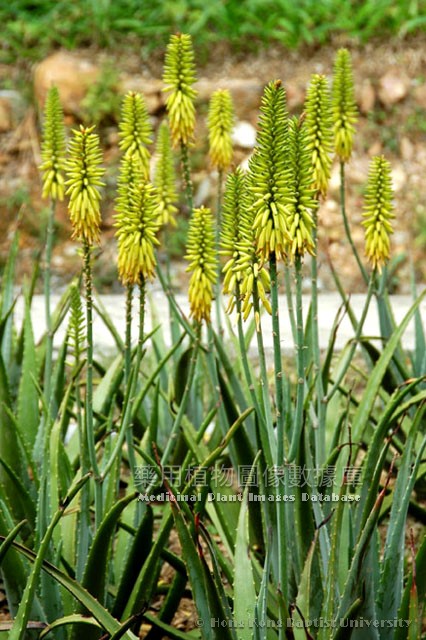
Perennial herbs. Stem extremely short. Leaves clustered on top of stem, nearly erect or erect, thick and fleshy; leaves pink-green, narrowly lanceolate or linear-lanceolate, 15-36cm long, 2-6cm wide, apex long and acuminate, base wide, margin sparsely covered with small prick-shaped teeth. Racemes scattered, scapes solitary or slightly branched, up to 0.9m; flowers drooping, ca. 2.5cm long, yellow or with red spots; perianth tubular, 6 lobed, lobes slightly outward bent, stamens 6, anthers t-shaped, length nearly the same as perianth; pistils 1, 3-chambered, each chamber with numerous ovules. Capsules, triangular, chambers cracked at the back. Flowering: February to March. |
|
Distribution |
Cultivated in southern provinces and green houses; can also be wild. The medicinal materials are mainly produced in Curacao, Aruba near the north bank of South America. |
|
Part Used |
Medical part: dried products concentrated from leaf juice, leaves, flowers and roots. Chinese name: dried products concentrated from leaf juice: Luhui. Leaves: Luhuiye. Flowers: Luhuihua. Roots: Luhuigen. |
|
Harvest & Processing |
Condensed dried products from leaf juice: harvested after 2-3 years of panting, partial collected the good leaves on the middle and under parts. Put inside containers with slot down and dried the juice flowing out. Washed the leaves, sliced, added water in the same amount, boiled for 2-3 hours, filtered, condensed the filter liquor, poured into moulds and fry-dried or sun-dried, that is Luhuigao. Leaves: harvested throughout the year, used fresh or sun-dried. Flowers: harvested in June-July, used fresh or dried in shade. Roots; harvested throughout the year, cut into sections and sun-dried. |
|
Chemistry |
Leaves contain barbaloin; ester made up by aloeresitannol and cinnamic acid; amino acid; cholesterol, lupeol; organic acid: malic acid; inorganic elements: Na, K, Ca, Mg Cl; polysaccharose: aloeferan and D-glucose, etc. |
|
Pharmacology |
Diarrhea-causing, anti-bacteria, effective immune system and anti-tumor, hepatic-protective, resistant to stomach injury, tissue-damage-treating and skin-safeguarding; toxic. |
|
Properties & Actions |
Dried extraction from leaf juice: taste bitter, cold in nature. Leaves: taste bitter, harsh, and cold in nature. Flower: taste sweet, tasteless, and cool in nature. Root: taste sweet, tasteless, and cool in nature.Condensed drying products from leaf juice: purgation, clearing liver fire and killing parasites. Leaves: discharging fire, detoxicating, eliminating stasis and killing parasites. Flowers: suppressing cough, cooling blood for eliminating stasis. Roots: clearing heat for inducing diuresis and eliminating stasis. |
|
Indications & Usage |
Dried concentrated leaf juice: Used for constipation induced by accumulation of heat, headache induced by hepatic fire, conjunctival congestion and infantile convulsion, enterozoic abdominalgia, sarcoptidosis, hemorrhoids and fistula. Leaves: Used for conjunctival congestion, constipation, whitish and turbid urine, hematuria, infantile frightened epilepsy, malnutritional stagnation, burns and scalding injuries, amenorrhea, hemorrhoids, gaile, anthracia, furuncle and swelling caused by toxins, injuries from falls. Flower: Used for cough, coughing up blood, hematemesis, whitish and turbid urine. Root: Used for retarded growth in infants due to malnutrition and urinary tract infection.Condensed dry products from leaf juice: oral administration: made as pills or powders, or powdered for adding to capsules, 0.6-1.5g; not decocting. External application: appropriate amount, powdered for application. Not use in cases of spleen and stomach deficiency or pregnancies. Leaves: oral administration: decocting, 15-30g; or smashed to extract juice. External application: appropriate amount, fresh products smashed for application or extracted juice by twisting for erasing. Flowers: oral administration: decocting, 3-6g. External application: appropriate amount, decocted for washing. Roots: oral administration: decocting, 15-30g. |
|
Examples |
Dried products of concentrated leaf juice:
1. Unsmooth stool: true aloe (grind into powders) 35g, cinnabar (grind powder) 25g, drip good alcohol to prepare pills, take 15g at each time, swallow with alcohol.
2. Active phase of chronic hepatitis, low-grade fever of liver origin: aloe, figwortflower picrorhiza 1.5g each, amoorcorn tree bark 3g. Prepare pills with water, swallow 3g at each time, 2 times a day.
Leaves:
1. Conjunctival congestion due to hepatic fire, constipation: fresh aloe leaves 15g. Decoct in water and swallow.
2. Burns and scalding, sting by bees: fresh aloe leaves, pestled and apply externally, or smear with juice.
Flower:
1. Bronchitis, empsyxis and hematemesis due to tuberculosis: aloe flower 6-9g. Decoct in water and swallow.
2. Hematemesis with internal injury: fry aloe flower with alcohol and eat.
Root:
Urinary tract infection, hematuria: dried aloe root 15-30g. Decoct and swallow. |
| Link to |
 Phytochemical Image Database Phytochemical Image Database
|
|
Permanent URL:https://sys01.lib.hkbu.edu.hk/cmed/mpid/detail.php?herb_id=D01379 |
|
|
|


