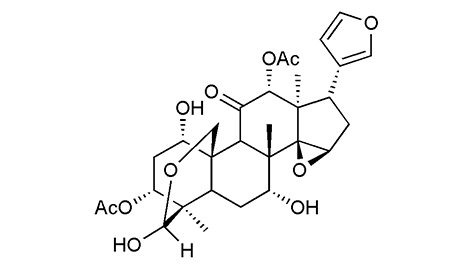
Name Toosendanin
Appearance Amorph. Powder
CAS No. 58812-37-6
Formulae
Molecular Weight 574.61
Natural Resources
Bioactivities
Identification Melting point 178-180°C
Optical rotation [α]D-31°
UV
IR
ESI-MS
1HNMR
13CNMR
Analytical Method
INSTRUMENT Silica gel G plate[9]
MOBILE PHASE Chloroform: acetone = 5: 2
DETECTION 0.25% : 4-Dimethylaminobenzaldehyde Sulfuric acid
INSTRUMENT Agilent 1100 series instrument equipped with PDA; Alltech 2000 ELS (Grace Company, IL)
COLUMN A YMC ODS-A column (25°C, 5 μm, 150 mm × 4.6 mm i.d.)
MOBILE PHASE A: Acetonitrile, B: water, 0-53 min 45-50% A ; 53-55 min 50-45% A; 1.0 mL/min
DETECTION UV λ205 nm
Sample Preparation
METHOD 1
5.0 kg sample were sonicated in 90% MeOH (15 L × 3) for 30 min. The MeOH extract was concentrated in vacuo to obtain residue (946.0 g), suspended in H2O (2 L), and partitioned with Et2O (2 L × 3). The aqueous layer was partitioned with l-butanol (2L × 3). Subjected Et2O soluble extract (125.5 g) to Diaion HP-20 column chromatography (15 cm i.d. × 30 cm), eluted with MeOH-H2O (0: 1 to 1: 0, each 20 l). Fractionated (18.9 g) of 90% methanolic fraction by silica gel column chromatography with C6H6-EtOAc (1: 0 to 0: 1).
The C6H6-EtOAc (8: 2) fraction (1.02 g) isolated by silica gel (CHCl3-MeOH/99: 1)
Reference
[1] Zhang, Y., et al. (2008). "Roles of reactive oxygen species and MAP kinases in the primary rat hepatocytes death induced by toosendanin." Toxicology 249(1): 62-68.
[2] Nakatani, M., et al. (1998). "Degraded limonoids from Melia azedarach." Phytochemistry 49(6): 1773-1776.
[3] Liu, Z. L. and S. H. Ho (1999). "Bioactivity of the essential oil extracted from Evodia rutaecarpa Hook f. et Thomas against the grain storage insects, Sitophilus zeamais Motsch. and Tribolium castaneum (Herbst)." Journal of Stored Products Research 35(4): 317-328.
[4] Wang, Z.-F. and Y.-L. Shi (2001). "Modulation of inward rectifier potassium channel by toosendanin, a presynaptic blocker." Neuroscience Research 40(3): 211-215.
[5] Tang, M.-Z., et al. (2003). "Toosendanin induces outgrowth of neuronal processes and apoptosis in PC12 cells." Neuroscience Research 45(2): 225-231.
[6] Tang, M.-Z., et al. (2004). "Involvement of cytochrome c release and caspase activation in toosendanin-induced PC12 cell apoptosis." Toxicology 201(1-3): 31-38.
[7] Ma, Z., et al. (2013). "Effects of the botanical insecticide, toosendanin, on blood digestion and egg production by female Aedes aegypti (Diptera: Culicidae): topical application and ingestion." J. Med. Entomol. 50(1): 112-121.
[8] Zhang, J. and X. Zhong (2011). "Toxic effects of toosendanin and influence on Th1 cytokines contents in pregnant mice." Zhongguo Shouyi Kexue 41(1): 94-98.
[9] Liu, H. and H. Cui (2008). "Identification of the toosendanin in Fructus Toosendan by TLC." Shizhen Guoyi Guoyao 19(7): 1674.
[10] Su, S., et al. (2013). "Characterization of tautomeric limonoids from the fruits of Melia toosendan." Phytochemistry Letters 6(3): 418-424.
[11] Tada, K., et al. (1999). "Limonoids from fruit of Melia toosendan and their cytotoxic activity." Phytochemistry 51(6): 787-791.
Link to Chinese Medicinal Material Images Database Medicinal Plant Images Database Chinese Medicine Specimen Database

Permanent URL: https://sys01.lib.hkbu.edu.hk/cmed/pid/detail.php?code=P00093