|
Perilla frutescens (L.) Britt.
|
Latin name |
Perilla frutescens (L.) Britt. |
|
Family & Genus |
Lamiaceae, Perilla |
|
Description |
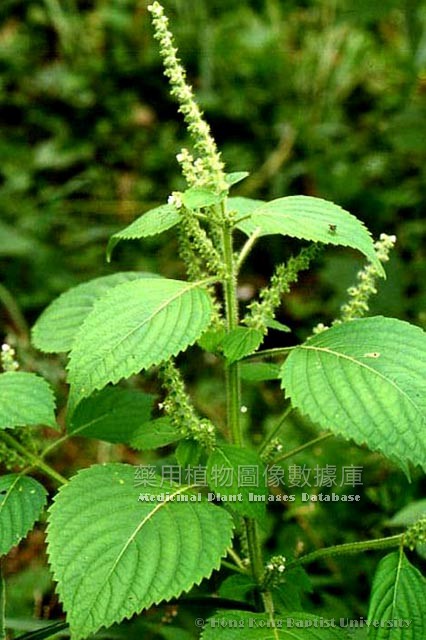
Annual aromatic herb, up to 0.5-2m high. Stems erect, blunt with four prismatic grooves, densely villous. Leaves opposite; petiole length 3-5cm, densely villous; leaf blade broadly ovate or broadly cuneate, coarsely serrate, both sides green or purple, puberulous above. Verticillaster inflorescence with 2 flowers, growing in a group of 1.5-15cm, densely villous, deviating towards one side of the terminal and axillary racemes; bracts broadly ovate or suborbicular, mucronate, with reddish brown glandular dots outside and a membraneous margin, pedicels densely pilose; calyx campanulate and straight, 10 veins, with long fluff and yellow glandular dots on lower part, puberulous ring inside the neck, calyx mast bilabiate, upper lip wide with 3 teeth, middle tooth smaller, lower lip slightly longer than upper lip, 2 teeth, teeth are lanceolate; corolla usually white, and corolla tube is short, 2-2.5mm long, limb nearly two bilabiate, upper lip emarginate, lower part cleft in 3, middle lobe larger; stamens 4, anterior pair is slightly longer and distinct, anther has 2 locules; style apex is 2 lobed; finger-shaped enlargement at disk anterior. Nutlet subglobose, greyish brown and netted. Flowering: August to November; fruiting: August to December. |
|
Distribution |
Cultivated throughout the country, rarely wild. Distributed in parts from Hebei to the south of the Yangtze River. The medicinal materials are mainly produced in Jiangsu, Shandong, Hubei and etc. |
|
Part Used |
Medical part: fruits, leaves and stems. Chinese name: fruits: Baisuzi. Leaves: Baisuye. Stems: Baisugeng. |
|
Harvest & Processing |
Baisuzi: collected in autumn when fruits become mature, harvested aboveground part, threshed down the fruits, removed foreign matters, and sun-dried. Baisuye: collected in summer and autumn, placed in drafty area and dried in shade, or collected with tender stem, cut into small segments, and sun-dried. Harvested old stem in autumn when fruits become mature, removed pericarp and branches and leaves, and sun-dried. |
|
Chemistry |
Baisuzi: seed oil contains perilaldehyde, egomaketone, matsutake alcohol and linalool. Leaves contain perillaldhyde, perillake-tone, elsholtziaketone, limonene, pinene, myristicin, dillapiol and stigmasterol, etc. |
|
Pharmacology |
Blood-fat-regulating and anti-tumor, antithrombus, nervous-system-influencing, laxative, immune-system-influencing and anti-bacterial. |
|
Properties & Actions |
Pungent, warm.Seeds: reducing qi, removing phlegm, moistening intestine and relaxing bowel. Leaf: ventilating lung, reinforcing qi, promoting digestion, detoxifying fish and crab poison. Stem: activating qi-flow, promoting digestion, easing pain and preventing miscarriage. |
|
Indications & Usage |
Common perilla fruit: coughing with dypnea and humid asthma, qi stagnancy and constipation. Common perilla leaves: common cold induced by pathogenic wind-cold, dyspnea and coughing, gastric and abdominal swelling pain, accumulation of food in the stomach and intestine due to indigestion, vomiting and diarrhea, cold dysentery, over indulgence of fish and crab. Edema in male private parts, limb emphysema, bites by snakes and insects. Common perilla stem: dyspeptic retention due to indigestion, gastric and abdominal swelling pain, common cold, restless fetal movement.Perilla frutescens: oral administration: decocting, 5-10g. Common perilla leaf: oral administration, 5-10g, or powdered; external application: appropriate amount, mixed with vinegar for application. Common perilla stem: oral administration: decocting, 5-10g. |
|
Examples |
Common perilla fruit:
Treat phlegm and cough: common perilla fruit 9-15g, orange peel 9-15g, decoct in water and swallow,prepare and swallow after sleeping to promote slight perspiration. |
| Link to |
 Chinese Medicinal Material Images Database
Phytochemical Image Database
Chinese Medicine Specimen Database Chinese Medicinal Material Images Database
Phytochemical Image Database
Chinese Medicine Specimen Database
|
|


