|
Allium tuberosum Rottl. ex Spreng.
|
English Name |
Chinese Chives, |
|
Latin name |
Allium tuberosum Rottl. ex Spreng. |
|
Family & Genus |
Liliaceae, Allium |
|
Description |
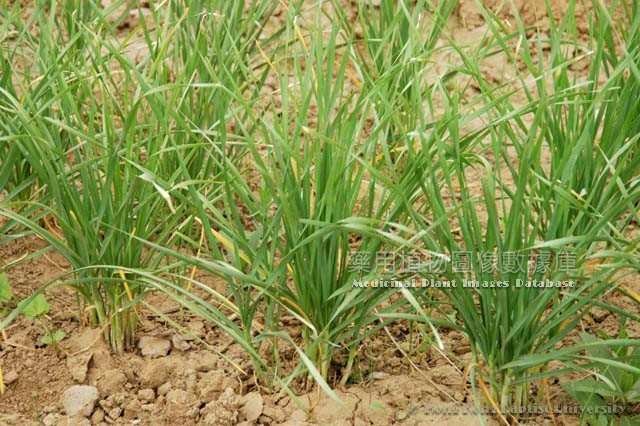
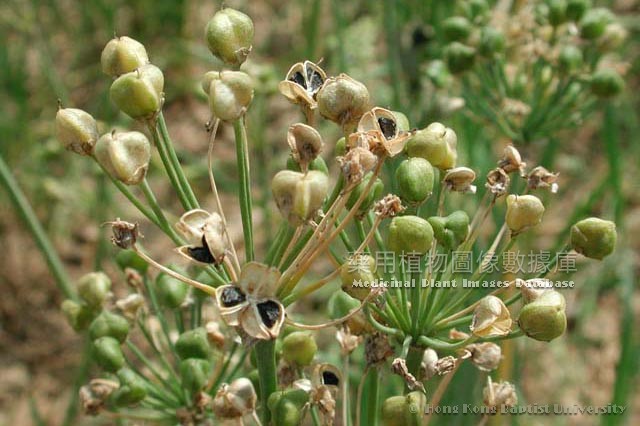
Perennial herbs, 20-45cm tall. With strong odour. Rhizomes lie on ground, bulbs conic, clustered; bulbs' covering skin yellow-brown, reticular fibered. Basal leaves, bar-shaped, flat, 15-30cm long, 1.5-7mm wide. Involucres 2 lobed, shorter than inflorescences, persistent; umbels clustered, numerous flowers; pedicels 2-4 times longer than perianth; with bracts; flowers white or with red; tepals 6, narrowly ovate, 4.5-7mm long; length of filaments 4/5 of that of tepals, base connate, basiconic; ovary outer wall bulging. Capsules. Flowering and fruiting: July to September. |
|
Distribution |
Cultivated nationwide. Distributed in Japan, South Korea and Taiwan. The medicinal materials are mainly produced in Heilongjiang, Jilin, Liaoning and etc. |
|
Part Used |
Medical part: leaves. Chinese name: Jiucai. |
|
Harvest & Processing |
Excavated from July to August or in late Sept Removed aboveground stem and fibrils, well washed, scaled with boiled water and stripped outer bark, sun-dried or fire-dried, removed stem base, washed, and cut into section and sun-dried. |
|
Chemistry |
Mainly contains sulfide, glycosides and amaroid. |
|
Pharmacology |
Middle-jiao warming and qi-promoting, blood-stasis-dissipating and detoxifying. |
|
Properties & Actions |
Pungent, warm, non-toxic.Warming kidney and benefiting yang and relieving hemorrhage. |
|
Indications & Usage |
Thoracic obstruction, achalasia of cardia, regurgitation, hematemesis, non-traumatic hemorrhage, hematuria, dysentery, diabetes, prolapse of hemorrhoids, anal prolapse, injuries from falls, bites of insects and scorpion stings.Oral administration: smashed to extract juice for drinking, 50-100g; or cooked. External application: smashed for application, extracted juice for dripping on affected part, stir-heated for ironing or decocted for fumigating and washing. Not use in cases of interior heat due to yin deficiency, ulcer or optical illness. |
|
Examples |
1. Treat thoracic obstruction, pricking pain of heart, the patient can not bend or look up, with spontaneous perspiration, or pain moving upward, incurable and resulting in death: fresh chive or root 5 jin (washed), pound juice. Swallow a little to vomit evil blood in thoracic cavity.
2. Treat yang asthenia and kidney coldness, impotence, or cold pain of waist and knee, emissions: chive 8 liang, English walnut meat (removing peel) 2 liang. Fry with sesame, eat every day continuously for a month.
3. Treat regurgitation: chive juice 2 liang, cow milk 1 cup. Mix evenly with fresh ginger juice. Warm up and swallow. |
| Link to |
 Chinese Medicinal Material Images Database
Chinese Medicine Specimen Database Chinese Medicinal Material Images Database
Chinese Medicine Specimen Database
|
|


