|
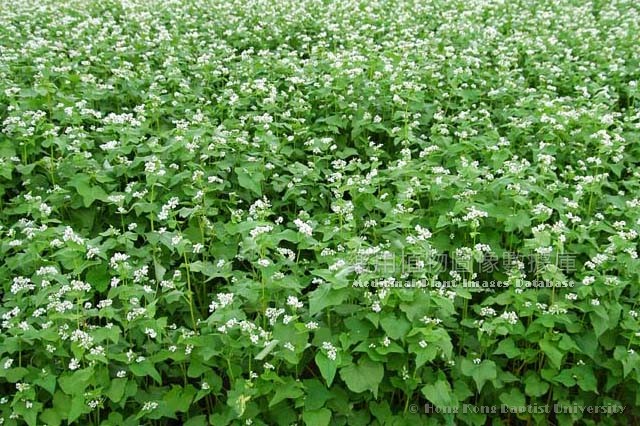
Fagopyrum esculentum Moench
|
English Name |
Common Buckwheat, Buckwheat |
|
Latin name |
Fagopyrum esculentum Moench |
|
Family & Genus |
Polygonaceae, Fagopyrum |
|
Description |
Annual herb. Stem upright, 40-110cm tall, upper part branched, smooth, green or red, with longitudinal ridges, sometimes grown with sparse mastoid processes. Leaf alternate, leaf in lower part with long stipe, leaf in upper part nearly sessile; ocrea shortly tubular. Apex oblique and truncate, caducous; lamina cardioidly triangular to form a triangular arrow, some nearly quinquangular, 2.5-5cm long, 2-4cm wide, tip gradually pointed, lobe in lower part round or gradually pointed, basal part nearly cardioid or hastate, leaf vein covered by mastoid processes. Inflorescence common or corymbose, basidixed or axillary; one side of peduncle with small processes; bract ovate, green, each bract with 3-5 flowers inside; peduncle longer than bract; perianth 5 deeply lobed, light red or white, lobe elliptic, 3-4mm long; stamens 8, shorter than perianth, anther light red; style of pistil 3, stigma head shaped. Achene triangular ovate or triangular, tip gradually pointed, with 3 ridges, brown, longer than persistent perianth. Flowering in May to September, fruiting in June to October. |
|
Distribution |
Originating in the Central Asia. Distributed and cultivated in all parts of China. The medicinal materials are mainly produced in Jiangsu, Zhejiang and etc. |
|
Part Used |
Medical part: seeds. Chinese name: Qiaomai. |
|
Harvest & Processing |
Harvested mature seeds around Frost Descend, knocked down seeds, removed impurities, and sun-dried. |
|
Chemistry |
Seeds contain quercitin, quercitrin, hyperoside, rutin, O and P-β-D-glucopyranosyloxy benayl amine, oleic acid, linolenic acid, and carotinoid and chlorophyll. Also contains three kinds of trypsin inhibitor. |
|
Pharmacology |
Decompressing, blood-fat-lowering, hpyerglycemic and trypsin-inhibiting. |
|
Properties & Actions |
Sweet, little sour, cold.Stimulating appetite and intestinal activity, depressing qi and dispersing accumulations. |
|
Indications & Usage |
Used for dry cholera, stagnation of intestine and stomach, chronic diarrhea, dysentery with vomiting, traveling erysipelas, carbuncles on back, scrofula, scalding and burns.Oral administration: made as pills or powders. External application: powdered or applied after mixed with fluid. Not use in cases of deficient-cold in spleen and stomach. |
|
Examples |
1. Whitish and turbid urine in males, leukorrhea with reddish discharge: common buckwheat stir-fried, grind into powder, prepare with egg white and pills as large as firmianae semen. Swallow 50 pills each time, with salty soup, take 3 times a day.
2. Fasting dysentery: common buckwheat, eat 6g each time. Swallow with granulated sugar. |
| Link to |
 Chinese Medicine Specimen Database Chinese Medicine Specimen Database
|
|


