|
Sechium edule (Jacq.) Swartz
|
English Name |
Chayote, |
|
Latin name |
Sechium edule (Jacq.) Swartz |
|
Family & Genus |
Cucurbitaceae, Sechium |
|
Description |
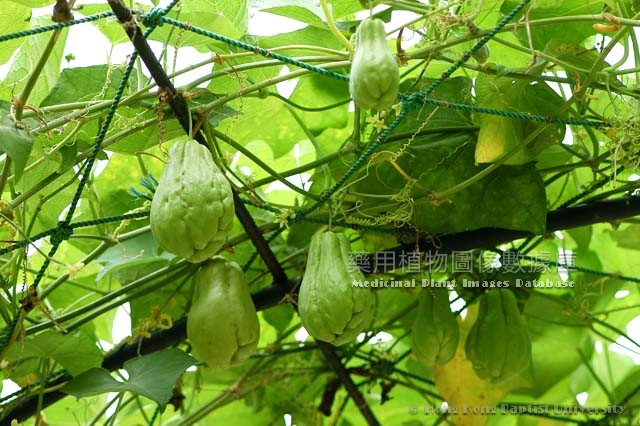
Creeping vine, tendrils 2-5 divergent, tendrils grow in direction opposite to leaves. Often 3 divergent. Leaves cordate, dark green, leaves alternate. Entire. 10-20cm long, 10-20cm wide, apex acute, base cordate, usually 3-5 cleft, serrulate edge, surface rough. Stem crawling or climbing, numerous tendrils, climbing ability strong. Unisexual flower, monoecious, axillary; male flowers in racemes, light yellow, corolla 5 cleft, filaments of stamen connate at base; Female flowers often solitary leaf axils. Fruit pear-shaped, surface with longitudinal grooves, containing one seed inside, flat spindle-shaped, linked together with pulp, no dormancy stage for seed, sprouting naturally inside the fruit body when mature. Flowering: July to September, fruiting: August to October. |
|
Distribution |
Originating in Mexico, Central America, the West Indies and etc. Cultivated or wild in Yunnan, Guangxi, Guangdong and etc of China. |
|
Part Used |
Medical part: leaves and fruits. Chinese name: leaves: Foshouguaye. Fruits: Foshouguaguo. |
|
Harvest & Processing |
Leaves: collected and triturated for external application. Fruits: collected when fruits become mature and used fresh. |
|
Properties & Actions |
Cool, sweet.Leaf: clearing heat and dispersing swelling. Fruit: tonifying spleen, promoting digestion, activating qi-flow and relieving pain. |
|
Indications & Usage |
Leaves: pyocutaneous disease and swelling, trauma. Fruits: gastralgia, dyspepsia.Leaf: external application. Fruit: fresh use (fruit can be used as vegetable). |
|
Permanent URL:https://sys01.lib.hkbu.edu.hk/cmed/mpid/detail.php?herb_id=D01239 |
|
|


