|
Brassica juncea (Linn.) Czern. et Coss.
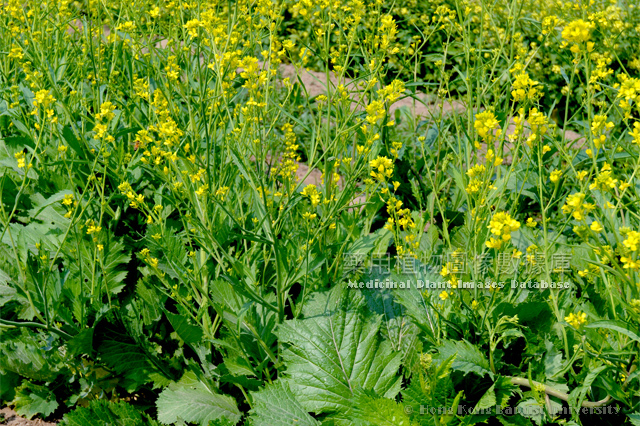
|
English Name |
Indian Mustard, Leaf-mustard, Brown Mustard |
|
Latin name |
Brassica juncea (Linn.) Czern. et Coss. |
|
Family & Genus |
Brassicaceae, Brassica |
|
Description |
Annual or biennial herbs, 0.5-1.5m tall; glabrous or young stem and leaves with seta, slightly with pruina. Stem erect, multi-branched. Basal leaves wide-ovate or obovoid, 15-35cm long, 5-17cm wide, apex obtuse, non-dividing or lyrate, margin with double serrations or incisions, petioles 3-9cm long, with small lobes, cauline leaves relatively small, not amplexicaul; leaves at upper part of stem have narrow sebaceous gland, 2.5-5cm long, sparsely not prominent serrate or margin entire. Raceme extended after flowering. Sepals oblong-elliptic, 4-5mm long, erect and expanded; petals bright yellow, margin entire, obovoid, 0.8-1cm long, base claw 4-5mm long. Stamens 6, 4 long 2 short, long stamens 8mm long, short stamens 6mm long; pistil 1, ovary cylindrical, ca. 1mm long, style fine, stigma headed. Siliqua linear, 3-5.5cm long; fruits middle vein protruding, beak 0.6-1.2cm long. Seeds spherical, diameter 1mm, purple-brown. Flowering: March to May; fruiting: May to June. |
|
Distribution |
Cultivated in all parts of China. The medicinal materials are mainly produced in all parts of China. |
|
Part Used |
Medical part: tender stem, leaves, seed and juice. Chinese name: tender stem: Jiecai, Youjiecai. Seed: Jiezi. Aged Juice: Chenjiecailuzhi. |
|
Harvest & Processing |
Tender stem and leaves: collected in autumn, used fresh or sun-dried. Seeds: from June to July, when mature fruits turn yellow, harvested entire plant, sun-dried, threshed down seed and winnowed foreign matters. |
|
Chemistry |
Root contains eleven kinds of volatile isothiocyanates, such as methylisothiocyanate, isopropyl isothiocyanate, etc. Leaves contain cyclobrassinin, brassilexin, cyclobrassinin sulfoxide, aristolochic acid. Pollen containas mustard oil glycosides, such as prop-2enyl glucosinolate. Seed contains mustard oil glycosides, such as sinigrin, gluconapin, glucobrassicin, progoitrin, myrosin and sinapic acid sinapine. |
|
Pharmacology |
Neuralgia, rheumatalgia, pleuritis and sprain curing, salivary-secretion and amylase-activity increasing; toxic. |
|
Properties & Actions |
Tender stem, leaves: taste pungent, warm in nature. Seeds: taste pungent, hot, mild-toxic in nature. Old marinades: taste salt, cold in nature.Tender stem, leaf: benefiting lungs, removing phlegm, dispersing swelling and dissipating stasis. Seed: warming inside, clearing cold, removing phlegm, warming the meridians and dispersing swelling. Aged juice: clearing phlegm and discharging pus. |
|
Indications & Usage |
Tender stems and leaves: Used for cough due to cold fluid-retention, adverse rising of qi due to stagnation of phlegm, distress of chest and diaphragm, stony stranguria, stranguria caused by urinary stone, swelling and ulcer of gum, mammary abscess, swelling hemorrhoids, perfrigeration, dermatitis rhus. Seeds: Used for gastrofrigid vomiting, cold pain of heart and abdomen, cough with asthma, excessive phlegm, lockjaw, deafness, pharyngitis, rheumatic arthralgia, limb numbness, amenorrhea, fat and clumsy, scrofula. Age thick gravy: Used for asthma with pulmonary abscess, stinking phlegm and bloody pus, and swelling and pain in throat.Tender stem, leaf: oral administration: decocting, 10-15g; or extracted juice for used fresh. External: appropriate amount, fumigate with decocted water, or powered for application. Seed: oral administration: decocting, 3-9g; or made as pills or powders. External: appropriate amount, powdered for application. Aged juice: oral administration: stew warm, 30-400ml per time, 3-4 times per day. |
|
Examples |
Tender stem, leaves:
1. Vesical calculus, obstructed urine: fresh Indian Mustard 2.5g, cut into pieces, decoct in an appropriate volume of water into 3 bowls of water, and swallow in several times.
2. Swelling pain of hemorrhoids: shepherd's purse leaves, pestle into cake shape, and sit on the cake frequently.
Seed:
1. Cholera, vomiting and diarrhea: pestle Indian Mustard seeds into fine powder, mix in water and apply onto umbilicus.
2. Adiaphoresis due to cold sense: prepare Indian Mustard seed powder with water and fill into umbilicus, scald with hot items on clothes, and it is good after perspiration.
Aged thick gravy:
Vomiting of pus and blood and cough due to pulmonary abscess, face edema: aged Indian Mustard gravy buried underground, take dozens of spoons each day, stew in soup and drink. |
| Link to |
 Chinese Medicinal Material Images Database Chinese Medicinal Material Images Database
|
|


