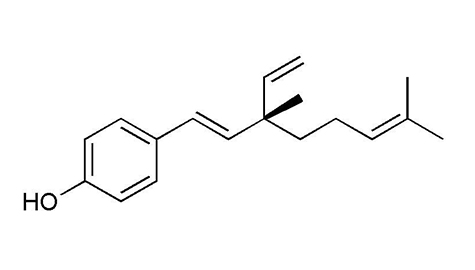
|
Natural Resources |
|
|
Bioactivities |
|
|
Identification |
Optical rotation |
[α]30D +37.2° |
1HNMR


|
| Analytical Method |
|
| INSTRUMENT |
Silica gel, high-performance TLC [HPTLC] plate, 1 mm; Merck |
| MOBILE PHASE |
20% (v/v) EtOAc in n-hexane |
| DETECTION |
UV λ254 nm |
|
|
|
| INSTRUMENT |
Agilent1290 Infinity UPLC system (Agilent Technologies, Santa Clara, CA) |
| COLUMN |
Hypersil GOLD C4 column (50 mm × 2.1 mm i.d., 1.9 µm particle size, Thermo Fisher Scientific, Waltham, MA) |
| MOBILE PHASE |
A: 0.1% formic acid in water, B: 0.1% formic acid in acetonitrile, the flow rate : 0.5 mL/min: 0 min, 30% B; 0.4-1.0 min, 90% B; 1.2 min, 30% B;0.3 min, re-equilibration time |
| DETECTION |
ESI-positive ion multiple reaction monitoring (MRM) mode; transfer capillary temperature: 320°C, spray voltage: 4000 V, sheath gas: 25 psi, m/z 490 → m/z 171.1 |
|
|
|
| INSTRUMENT |
Waters 515 Separations Module HPLC system and a Waters 2487 diode-array detector |
| COLUMN |
Hypersil ODS2 column (250 mm × 4.6 mm i.d., 5 µm particle size; Dalian Elite Analytical Instrument Co. Ltd., Dalian, China) |
| MOBILE PHASE |
Methanol: water (0.2% formic acid) = 90: 10, v/v; flow rate : 1.0 mL/min |
| DETECTION |
UV λ260 nm |
|
|
|
| INSTRUMENT |
Pump (Jasco, PU-2089, Tokyo, Japan) and a UV detector (Jasco, UV-2075) |
| COLUMN |
XTerra™ RP18 column (4.6 mm × 250 mm, 5 µm; Waters Co., MA, USA) |
| MOBILE PHASE |
A: 0.1% water-acetic acid, B: acetonitrile, 0-15 min 60% A, 15-35 min 60-50% A, 35-45 min 50-40% A, 45-55 min 40-30% A, 55-60 min 30-20% A, 1mL/min |
| DETECTION |
UV λ245 nm |
|
|
|
| INSTRUMENT |
Agilent 1260 Infinity LC system with a DAD detector |
| COLUMN |
Alltima C18 column (Alltech, 4.6 × 250 mm, 5 µm) |
| MOBILE PHASE |
A: aqueous acetic acid, B: acetonitrile, 0-15 min 40-50% B, 15-35 min 50-60% B, 35-55 min 60-80% B, 55-60 min 80% B, 1.0 mL/min |
| DETECTION |
UV λ251 nm |
|
|
|
| INSTRUMENT |
1100 HPLC instrument (Agilent Technologies, California, USA) |
| COLUMN |
DL-C18 column (5.0mm, 250 mm, 4.6 mm, Japan) |
| MOBILE PHASE |
A: Acetonitrile, B: 0.01 M formic acid : 0-10 min 15-40% B, 10-30 min 40-55% B, 30-40 min 55-75% B, 40-60 min 75-80% B, 60-70 min 80-95% B, back to 15% A; flow rate: 0.5 mL/min |
| DETECTION |
UV λ276 nm |
|
| Sample Preparation |
|
METHOD 1 |
|
|
Extract the dried seeds powder of P. corylifolia (2.0 kg) with 95% EtOH to give 592 g crude, suspend part of which (392 g) in 2.5 L water. |
|
|
Extract was partitioned with petroleum ether and ethyl acetate successively to give petroleum ether soluble fraction PE (143 g) and ethyl acetate soluble fraction EA (120 g). |
|
|
Subject EA (100 g) to silica gel column chromatography (CC) eluted with an increasingly gradient of acetone in petroleum ether to obtain nine fractions Frs 1-9 according to TLC monitor. Frs 1-4 (total 46 g) mainly contained bakuchiol |
|
|
| Reference |
|
[1]
|
Zhuang, X., et al. (2013). "Pre-column derivatization combined with UPLC-MS for rapid and sensitive quantification of bakuchiol in rat plasma." Journal of Pharmaceutical and Biomedical Analysis 75(0): 18-24. |
|
[2]
|
Park, E.-J., et al. (2007). "Bakuchiol-induced caspase-3-dependent apoptosis occurs through c-Jun NH2-terminal kinase-mediated mitochondrial translocation of Bax in rat liver myofibroblasts." European Journal of Pharmacology 559(2-3): 115-123. |
|
[3]
|
Chen, Z., et al. (2010). "Anti-tumor effects of bakuchiol, an analogue of resveratrol, on human lung adenocarcinoma A549 cell line." European Journal of Pharmacology 643(2-3): 170-179. |
|
[4]
|
Pae, H.-O., et al. (2001). "Bakuchiol from Psoralea corylifolia inhibits the expression of inducible nitric oxide synthase gene via the inactivation of nuclear transcription factor-κB in RAW 264.7 macrophages." International Immunopharmacology 1(9-10): 1849-1855. |
|
[5]
|
Kim, K.-A., et al. (2013). "Protective effects of the compounds isolated from the seed of Psoralea corylifolia on oxidative stress-induced retinal damage." Toxicology and Applied Pharmacology 269(2): 109-120. |
|
[6]
|
Lim, S. H., et al. (2009). "Ethanol extract of Psoralea corylifolia L. and its main constituent, bakuchiol, reduce bone loss in ovariectomised Sprague-Dawley rats." Br J Nutr 101(7): 1031-1039. |
|
[7]
|
Haraguchi, H., et al. (2002). "Antioxidative components of Psoralea corylifolia (Leguminosae)." Phytother Res 16(6): 539-544. |
|
[8]
|
Miao, L., et al. (2013). "Bakuchiol inhibits androgen induced-proliferation of prostate cancer cell line LNCaP through suppression of AR transcription activity." Tianjin Zhongyiyao 30(5): 291-293. |
|
[9]
|
Katsura, H., et al. (2001). "In vitro antimicrobial activities of bakuchiol against oral microorganisms." Antimicrob Agents Chemother 45(11): 3009-3013. |
|
[10]
|
Katsura, H., et al. (2001). "In vitro antimicrobial activities of bakuchiol against oral microorganisms." Antimicrob Agents Chemother 45(11): 3009-3013. |
|
[11]
|
Yan, D.-M., et al. (2010). "In vivo pharmacokinetics of bakuchiol after oral administration of bakuchiol extraction in rat plasma." Journal of Ethnopharmacology 128(3): 697-702. |
|
[12]
|
Lim, S.-H., et al. (2011). "Estrogenic activities of Psoralea corylifolia L. seed extracts and main constituents." Phytomedicine 18(5): 425-430. |
|
[13]
|
Chen, X., et al. (2013). "Isobavachalcone and bavachinin from Psoraleae Fructus modulate Aβ42 aggregation process through different mechanisms in vitro." FEBS Letters 587(18): 2930-2935. |
|
[14]
|
Chen, Q., et al. (2012). "Separation, identification, and quantification of active constituents in Fructus Psoraleae by high-performance liquid chromatography with UV, ion trap mass spectrometry, and electrochemical detection." Journal of Pharmaceutical Analysis 2(2): 143-151. |
|
[15]
|
Yin, S., et al. (2006). "Psoracorylifols A-E, five novel compounds with activity against Helicobacter pylori from seeds of Psoralea corylifolia." Tetrahedron 62(11): 2569-2575. |
|
| Link to |
 Chinese Medicinal Material Images Database
Medicinal Plant Images Database
Chinese Medicine Specimen Database Chinese Medicinal Material Images Database
Medicinal Plant Images Database
Chinese Medicine Specimen Database
|